
MP3 Bitrate Explained: 128 vs 192 vs 320 kbps in Real Listening Tests
Blind tests say most people can't pick 320 from 192 on most tracks — but the exceptions matter. What bitrate actually trades away, with file-size math per album.
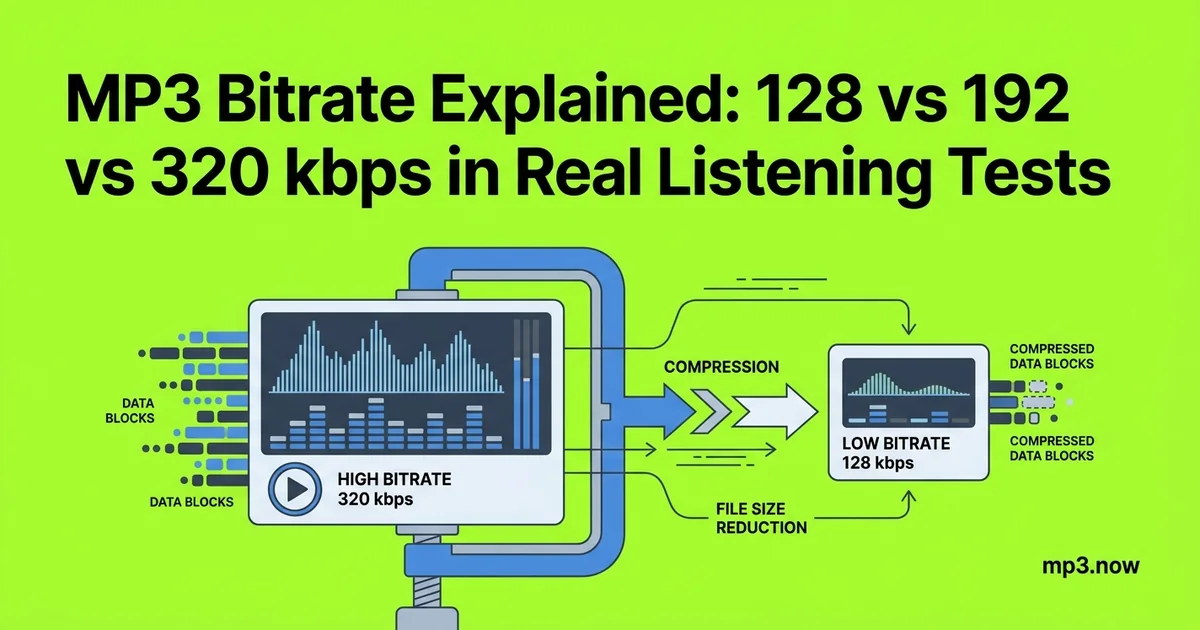
Ask an internet forum whether 320 kbps sounds better than 128 kbps and you will get certainty in both directions: audiophiles who claim 320 is the bare minimum for human dignity, and cynics who insist nobody can hear past 128. Blind listening tests — the only evidence that matters here — say something more interesting than either camp: the difference between 128 and 192 is real and fairly often audible; the difference between 192 and 320 is genuinely hard to detect for most people on most material; and the exceptions cluster in predictable places. Here is what bitrate actually buys, what the tests show, and the file-size math for deciding where your library should sit.
What bitrate actually is
Bitrate is data budget: how many bits the encoder may spend describing each second of sound. At 320 kbps it spends 320 kilobits (40 KB) per second; at 128 kbps, 16 KB per second. MP3 is a perceptual codec — it discards the parts of the signal psychoacoustic models predict you cannot hear, starting with quiet details masked by louder ones. The lower the bitrate, the more aggressively it discards, and the sooner it starts cutting things you can hear. (A broader primer lives in this practical bitrate guide.)
What degrades first is specific: high-frequency shimmer (cymbals, hi-hats), dense chaotic textures (applause, rain, distorted guitar walls), and sharp transients, which can develop "pre-echo" — a faint smear just before a sharp sound like a rimshot. Vocals and midrange melody survive almost untouched at every common bitrate, which is why casual listening hides the differences so well.
What blind tests actually show
- 128 vs 320: the most detectable gap. On revealing material — cymbal-heavy jazz, applause, harpsichord — trained listeners pick the 128 kbps file reliably; a "swishy" or underwater quality in the highs is the tell. On a mid-tempo rock or pop track through ordinary gear, plenty of listeners still fail this comparison.
- 192 vs 320: mostly statistical noise. Controlled ABX tests repeatedly show most participants — including self-described audiophiles — performing at or near chance. A small number of trained listeners pass consistently on specific killer samples, which is precisely what "transparent for most people on most material" looks like in data.
- The gear caveat: playback chain and listening environment dominate. Earbuds on a bus mask artifacts that studio monitors in a quiet room reveal. A bitrate upgrade you cannot hear on your actual equipment is spent on nothing.
The honest summary: 128 kbps is good but detectably imperfect; 192 kbps is transparent for the large majority; 320 kbps is insurance for critical listening, revealing material, and revealing gear.
The file-size math
Bitrate converts directly to size: kbps ÷ 8 = KB per second. Per minute of audio that is:
- 128 kbps: 0.96 MB/min — a 45-minute album ≈ 43 MB; 1,000 four-minute songs ≈ 3.8 GB
- 192 kbps: 1.44 MB/min — a 45-minute album ≈ 65 MB; 1,000 songs ≈ 5.8 GB
- 320 kbps: 2.4 MB/min — a 45-minute album ≈ 108 MB; 1,000 songs ≈ 9.6 GB
So 320 costs 2.5x the storage of 128 for a difference most listeners cannot reliably hear past 192. Whether that trade makes sense depends entirely on the constraint: on a 2 TB drive, nobody cares; on a 32 GB player or a metered upload, it decides how much music fits.
Practical recommendations by use
- Archiving a collection you care about: honestly, use lossless (FLAC) as the master, and generate MP3s from it as needed — see MP3 vs FLAC. If MP3 is the archive, make it 320 kbps: it is the ceiling, and you cannot upgrade later.
- Everyday listening library: 192 kbps is the sweet spot — transparent to nearly everyone, 40 percent smaller than 320.
- Speech (podcasts, lectures, audiobooks): voice needs far less than music; 64–96 kbps mono is standard and sounds clean.
- Tight storage or bandwidth: 128 kbps remains perfectly respectable for casual listening, which is why streaming services served it for years.
A five-minute test with your own ears
Rather than adopting anyone's conclusion — including this article's — run the comparison yourself, because your ears, your music, and your equipment are the only variables that matter. Take one track you know intimately, ideally something with cymbals or acoustic texture, and encode it at 128, 192, and 320 kbps using a bitrate changer. Listen on the gear you actually use, at the volume you actually use, switching between versions at the same passage. Most people discover one of two things: either they cannot tell 192 from 320 at all, which frees up 40 percent of their storage with a clear conscience, or they can hear it on exactly this kind of material, which tells them where their personal floor is. Ten minutes of honest listening settles a debate forums have sustained for twenty-five years.
The one-way street
The critical rule: bitrate conversion only works downward. Re-encoding a 128 kbps file at 320 kbps produces a bigger file with identical (or slightly worse) sound, because the detail was discarded at the first encode and no converter can invent it back. Downward conversion — 320 to 192 to fit a device, say, with a bitrate changer — is legitimate and works exactly as advertised; each re-encode of a lossy file does stack a little generational loss, so convert from the best source you have and avoid repeated round trips.
Bottom line
Stop optimizing bitrate by forum consensus and optimize it by constraint. If storage is free, 320 costs you nothing but disk. If space or bandwidth is tight, 192 gives up almost nothing audible, and 128 gives up less than its reputation suggests. And if you find yourself tempted to "upgrade" old low-bitrate files to 320 — don't; that money was spent the day they were first encoded.